It was a Tuesday afternoon in early March when the phone rang. The caller wasn't one of our usual corporate clients. He was a contractor, sounded like he was standing near a job site, and didn't have time for small talk. He needed twelve pairs of Dunlop hazmat boots in two weeks. His usual supplier had just dropped the ball.
I'm a quality compliance manager at an industrial safety equipment distributor. I review the products that go out to customers—boots, gloves, eye protection, the whole PPE shelf—before they get released. In 2025, I've rejected roughly 8% of first deliveries for spec mismatches, inconsistent materials, or bad finishing. That's not a number I'm proud of. It's just what happens when you actually check things.
Most of our orders are big. Plant managers. EHS directors at manufacturing facilities. Orders in the tens of thousands of dollars. Twelve pairs of boots? That's not a rounding error for us, but it's close. Plenty of distributors would tell a small contractor like that to call back when he had a real PO. I've heard the phrase small orders don't justify the paperwork. There was a time in my life when I might've said it myself.
In my first year on this job, I made the classic specification error. I assumed a hazmat boot was a hazmat boot, approved a shipment based on photos alone, and we delivered a generic equivalent with noticeably thinner rubber around the sole. The customer found out in the field. That cost us about $4,000 in rushed replacements. It also taught me two things: never trust a photo, and small customers remember when you cut corners for them.
What I Actually Check on Dunlop Rubber Boots
Now every order gets the same treatment, whether it's twelve pairs or twelve hundred. For Dunlop rubber boots, I check three things: the model number against the certification paperwork, the batch number, and the physical sample. That last one is the step that makes sales teams nervous. You can't verify rubber quality from a spreadsheet.
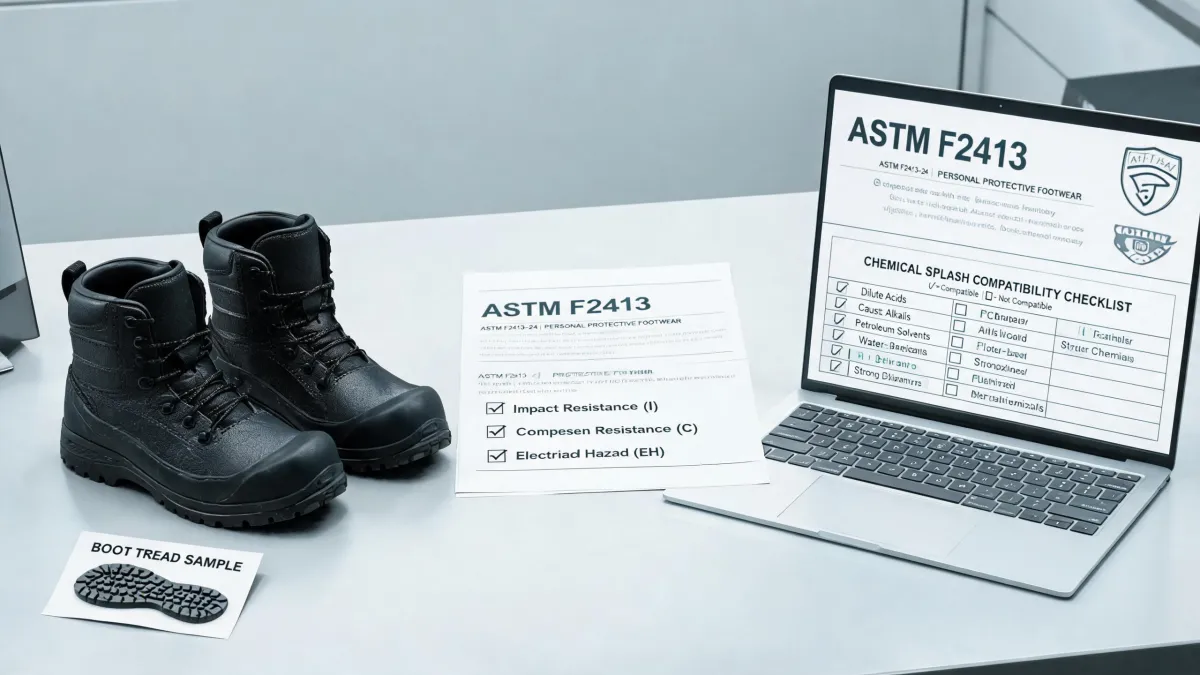
According to OSHA (osha.gov), employers need to provide foot protection when workers face hazards like falling objects, sharp materials, or dangerous liquids (29 CFR 1910.136). For hazmat work, you're asking the boot to do more than keep feet dry. You're asking Dunlop hazmat boots to be a chemical barrier. That means checking the compound, the seam integrity, and the sole bond. Anything with a toe cap also needs to meet the ASTM F2413 standard for protective footwear.
Style matters more than people think. This contractor asked for slip-on work boots. That's not just a preference. In hazmat environments, laces are a liability. They soak up whatever you're walking through, they hold onto contaminants, and they make decontamination a nightmare. Slip-ons can be hosed down and deconned without worrying about what's hiding in the laces.
On price: Dunlop hazmat boots aren't the cheapest option on the shelf. Based on online retailer listings I reviewed in early 2025, hazmat-rated styles list anywhere from $90 to $190 per pair, depending on the toe protection and the rubber compound. That's approximate, so verify current pricing—but for a piece of gear that's supposed to stop chemicals from reaching your feet, it's not unreasonable.
The Boots Arrived. Then the Problem Started.
The boots arrived nine days before the contractor needed them. Our warehouse team flagged the cartons as soon as they landed, and I pulled a full sample set into the inspection room.
The first eleven pairs were fine.
That was almost the problem. It's easy to see eleven good pairs and sign off on the twelfth without really looking. But something made me stop. There was a small gap in the rubber where the toe meets the sole. A quarter of an inch, maybe. On a pair of casual rain boots, you'd shrug it off. On hazmat boots, a gap like that means the boot isn't a barrier anymore. One step in the wrong puddle, and the person inside is wearing a contaminated boot.
I rejected the entire batch.
The supplier pushed back. Said it was within tolerance. You know what I've learned about that phrase? It only gets used when something went wrong. Our contract includes a batch-level photo verification requirement—the fix we put in place after my rookie mistake in year one—so the supplier was stuck. They redid the entire run at their cost.
Dodged a bullet there, and I mean that literally. If I hadn't checked the twelfth pair, those boots would've been on a cleanup site a week later. One chemical exposure, one regulatory citation, and we're not talking about a $4,000 replacement. We're talking about a worker's health and a small business getting crushed by liability.
The Safety Glasses vs. Goggles Question
Before the replacement boots arrived, the contractor asked me a side question. He'd seen basic safety glasses at a hardware store for $3 and wondered whether those would work for his crew. He wanted to save a few bucks.
I get this one a lot, and it gets confused more than it should.
- Safety glasses protect against impact. Nails, concrete chips, flying metal. They're fine in construction and machining, anywhere debris is the main risk.
- Goggles form a complete seal around the eye. That matters when you're dealing with splashes, sprays, mists, or dust that can get around the edges.
For hazmat work, the answer is basically goggles—or a full-face respirator with a built-in visor. Standard glasses don't seal. That's not a criticism of the $3 hardware store pair; it's just the wrong tool for a chemical environment. You don't pair a rubber boot with a mesh sneaker and call it good. The gear has to match the hazard.
The contractor ordered the goggles. He thanked me for explaining it without treating the question as stupid. That's another thing I've learned: small crews ask the same questions as big safety departments. They just have fewer people to ask.
What Happened Next
The replacement boots showed up four days later, with time to spare. Same model, same batch number, one verified pair at a time. The contractor made his deadline. The rush delivery didn't cost him anything extra, because the first failure was the supplier's cost, not his.
He still calls me when he needs PPE. But that's not the part I think about most.
Three months after that order, the same contractor passed my name to an environmental response firm he worked with. They called about a 300-pair order of Dunlop boots, plus goggles, face shields, and gloves. That first conversation turned into a contract worth well over a hundred thousand dollars.
So yeah. Small orders matter.
Lessons That Stick
I have mixed feelings about rush service premiums. On one hand, they feel like a tax on bad planning. On the other hand, I've watched suppliers scramble to redo a failed batch on a deadline, and that kind of chaos costs real money. What I don't have mixed feelings about is the way small customers get treated. Too many vendors see a small PO and assume it's not worth serious attention.
One thing that still surprises me is how people search for work boots online. Every week our analytics shows searches like rubber boots dunlop or vans work boots or safety glasses vs goggles (yes, really, people type phrases like that). Honestly, I get it. People aren't being sloppy—they're trying to figure out what gear actually works. So let me make it simple: start with the hazard, not the style. If you need waterproof or chemical-resistant protection, a quality rubber boot with a sealed seam is the answer. If you need an industrial boot that looks low-profile, there are slip-on styles that get you partway there. But the first question has to be: does this boot meet the standard for the site? The second is: does it fit the work? If you're walking through chemicals, you don't want a lifestyle sole. You want a boot that was tested for the actual hazard.
Quality isn't about being perfect. It's about being consistent. The first eleven pairs can be flawless, and the twelfth is the one that teaches you something. That's why I check the twelfth pair. That's why I treat a 12-pair order the way I'd treat a 12,000-pair order. Because the next call might be bigger than you expect—and even if it isn't, the person wearing the boots deserves the same standard.