-
First, Sort Your Job Sites Into Three Buckets
-
How We Used to Buy Boots (And Why I Stopped)
-
Scenario A: Waterproofing and Chemical Exposure → Look at Dunlop Hazardous Duty Boots
-
Scenario B: Steel Toe and Impact Protection → Compare Dunlop vs. Skechers Work Boots Carefully
-
Scenario C: Tactical Boots and Direct-to-Consumer Brands (like Brunt)
-
How to Tell Which Scenario You’re In
-
Bottom Line
There’s no single ‘best’ work boot. It depends on what your crew is actually doing on the job. I’ve been managing procurement for a mid-sized facility services company for about six years now, and I’ve tracked every boot order in our cost system. So when people ask me ‘which boots should we buy?’—I usually answer with a question: what are you walking into?
If you’re just looking for one recommendation, stop reading. But if you want to stop wasting money on replacements and injury claims, this is how I break it down from a total-cost perspective. I’m not a safety engineer, so I can’t speak to every ASTM spec. What I can tell you is how to think about the decision before you sign a purchase order.
First, Sort Your Job Sites Into Three Buckets
Before you compare price lists, you need to sort your operations. After auditing our 2023 and 2024 spending, I found that most teams fall into one of these three situations:
- Wet or hazardous ground: water, chemicals, mud, or slip hazards.
- Impact and compression risks: heavy loads, sharp objects, crushing hazards.
- Light-duty or multi-purpose: warehouses, supervision, maintenance, or tactical-style roles.
Seems basic, but you’d be surprised how many orders are placed based on ‘what was in stock’ rather than what the job actually demands. That’s how you end up with the wrong boot, a so-so price, and a foot injury later.
How We Used to Buy Boots (And Why I Stopped)
Five years ago, I approved a purchase order for 20 pairs of the cheapest steel toe boots I could find. The unit price was $45. I felt like a hero. Then the first injury report came in—a guy slipped on a wet surface and twisted his ankle because the sole had zero grip. No major damage, but he was off for two days. Then two more pairs literally split open within a month. We ended up buying replacements, paying for expedited shipping, and losing three days of labor. That ‘cheap’ order cost us about $1,800 in total. The lesson stuck: the lowest quote is just the starting line, not the finish.
I only believed that the more expensive boots were ‘worth it’ after ignoring warnings once and eating the cost. Now I calculate total cost per month. And that changes the conversation completely.
Scenario A: Waterproofing and Chemical Exposure → Look at Dunlop Hazardous Duty Boots
If your crew is dealing with water, acids, or any kind of liquid hazard, the boot type matters more than the brand. This is where Dunlop hazmat boots and their rubber line really shine. Their whole heritage is rubber dip molding, which means fewer seams, and no seams means no places for liquid to sneak in.
I’ll be honest: a pair of Dunlop hazmat boots costs more upfront than a no-name rubber boot. But here’s the thing I learned the hard way. When I compared a $65 pair of ‘waterproof’ boots against a $130 pair of Dunlop rubber boots side by side, I finally understood why the details matter so much. The cheap ones had a taped seam that failed in three weeks. The Dunlops were still dry after eight months. That’s not a tiny difference. That’s a replacement cycle difference.
Let me put it in numbers. Say you buy 20 pairs for your crew.
- Cheap boots at $65 × 20 = $1,300. If they fail in 3 months, you’re reordering four times a year. That’s $5,200 annually.
- Dunlop safety boots at $130 × 20 = $2,600. Even if they last a year and a half (which they usually do in our experience), you’re spending about $1,730 per year. That’s a $3,470 difference—just by counting replacements.
And that’s before you count a worker’s comp claim from a wet foot leading to dermatitis or a slip. You don’t want to learn that lesson on the back end.
If you’re searching for ‘dunlop safety boots waterproof,’ what you’re really asking for is a boot that doesn’t soak through at the first puddle. That’s exactly what these are built for. But make sure you pick the right model—some are more chemical-resistant, some have steel toe, some are insulated. Check the spec sheet, not just the photo.
Scenario B: Steel Toe and Impact Protection → Compare Dunlop vs. Skechers Work Boots Carefully
For general impact protection, you have a lot of options. Skechers work boots are popular because they’re comfortable and comparatively cheap. Let me say something that might sound controversial: I’m not knocking Skechers. They’re fine for lighter work sites. But when I see a request for ‘steel toe boots’ and the job involves climbing scaffolding or handling heavy metal, I push for a harder-wearing safety boot.
The reason isn’t nostalgia. It’s because your total cost includes that guy’s time out on workers’ comp if the boot fails. The ‘just buy the cheapest steel toe’ thinking comes from an era when safety boots were all heavy leather and you couldn’t get features like waterproofing without paying a ton extra. Today, you’ve got rubber, composite toe, waterproof membranes—you need to match the boot to the hazard.
Here’s a better way to think about it:
- Skechers work boots: Great for supervisors, inspectors, or warehouse workers who need a toe cap for occasional light hazards. Comfort is excellent, so you don’t need a long break-in period. But they’re not built for repeated heavy impact or chemical exposure.
- Dunlop steel toe/steel midsole boots: Better when you need more robust shielding. Dunlop also has metatarsal guard boots and insulated versions if you’re in colder conditions. The price is higher, but the boot lasts longer and gives you better protection in the specific scenarios.
My rule from years of tracking orders: if your crew is on smooth concrete or inside a facility with low hazards, buy the lighter boot and save money. If they’re outdoors, in mud, or around moving equipment, buy the tougher boot. The total cost per month is what matters, not the sticker price.
Scenario C: Tactical Boots and Direct-to-Consumer Brands (like Brunt)
Then there’s the third bucket—the jobs that are not exactly heavy industrial but need something reliable and professional. Tactical boots have grown in popularity because they’re often lighter, offer good ankle support, and work for both on-site security and field service techs. Some brands, like Brunt, sell directly to consumers, which keeps the upfront price down. I see a lot of people ask ‘who sells Brunt work boots?’—it’s mostly through their own website, with a few marketplaces. They’re priced aggressively, and some guys genuinely love them.
From a procurement perspective, the direct-to-consumer model has a hidden cost: your time. If you order 15 pairs and half of them have sizing issues, you’re dealing with return shipping, exchange delays, and a frustrated crew member standing around on day one. That’s not an attack on Brunt—that’s true for any brand that doesn’t have a local distributor.
I don’t have hard data on Brunt’s defect rate, but based on our own experience with online-only boot orders, I can tell you sizing is the biggest variable. If you’ve got one guy with a wide foot and another with a narrow heel, you’re going to spend hours on returns. Factor that into your total cost.
Tactical boots also tend to be less waterproof and less chemical-resistant than a dedicated rubber boot. So if your day includes stepping in slop, tactical probably isn’t the right primary boot—maybe for the office staff, but not for the field crew.
How to Tell Which Scenario You’re In
Here’s a quick checklist I use before every boot order.
- What’s underfoot? Water, chemicals, gravel, rebar, or clean concrete? If liquid is involved, go with rubber/waterproof options like Dunlop. If it’s dry but impact-heavy, look at steel toe with a real sole.
- How often do boots actually get replaced? Dig through your purchase history. If you’re replacing ‘cheap’ boots every few months, the total cost is probably higher than you think.
- What’s your crew’s foot shape? If you have many different sizes and widths, buying online-only might cost you more in exchanges. Find a brand that fits the majority, or order a fitting kit first.
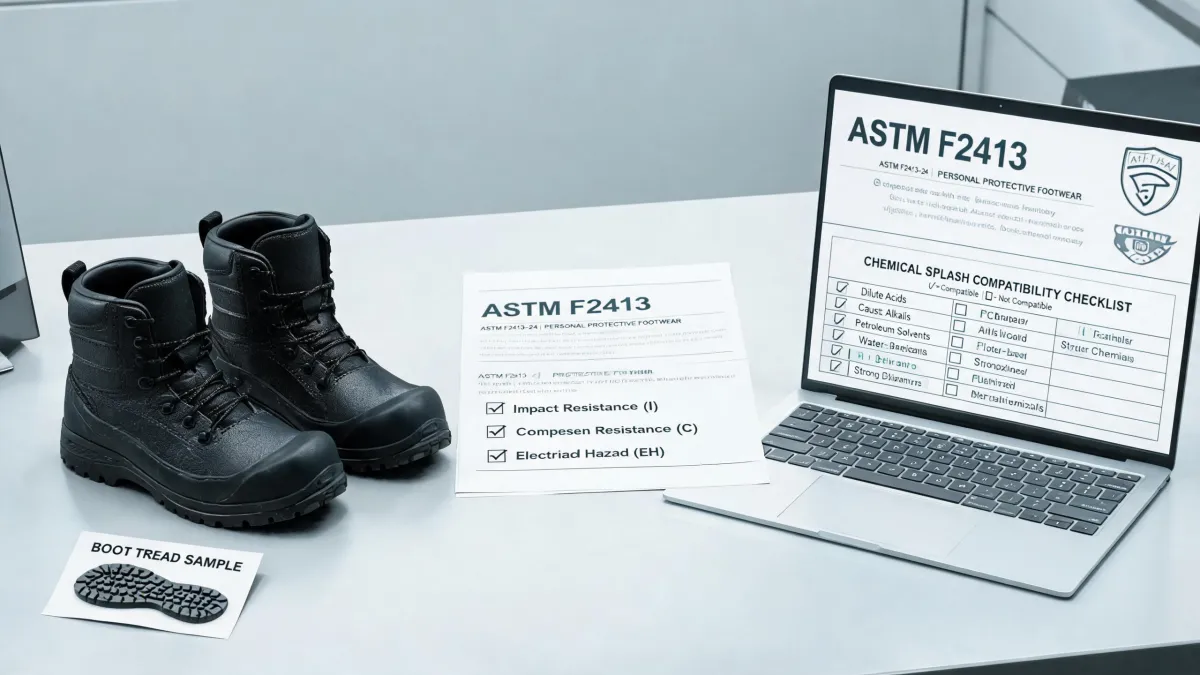
- Does the boot need to meet a specific standard? OSHA’s PPE rule (29 CFR 1910.136) basically says employers need to provide protective footwear when there’s a danger of foot injury. The standard doesn’t name brands—it names hazards. Check whether you need ASTM F2413-18 rated boots for impact/compression, or additional chemical resistance.
That last point is important. Don’t let a slick marketing page convince you that ‘rugged’ means ‘safe.’ Look for actual certification labels on the boot or packaging. As of February 2025, all our Dunlop boots come with clear ratings printed on the shaft. That makes my audits a lot easier.
Bottom Line
The cheapest boot on the invoice is rarely the cheapest boot you’ll ever buy. I’ve seen it happen in our own cost tracking: a $45 discount model ended up costing $120 per pair after replacements and lost time. If you want to make a smart buying decision, calculate the total cost over 12 months—not the per-unit price.
And if your crew works in wet, hazardous, or high-impact environments, don’t skimp on the actual protection. That’s not me showing favoritism to Dunlop—it’s just good procurement. If the job demands waterproofing, buy waterproof boots. If it demands a steel toe, buy a proper steel toe. Match the boot to the hazard, and your bottom line will take care of itself.
This is based on my own experience as a procurement manager. I don’t work for any boot brand. Always verify current model specs and safety certifications with the manufacturer before ordering.