-
Who This Checklist Is For
-
What Most Dunlop Hazmat Boots Reviews Won't Tell You
-
The 7-Point Checklist I Run On Every Order
-
Step 1: Identify what's actually on your floor
-
Step 2: Verify certifications against your jurisdiction
-
Step 3: Match the rubber compound to your chemicals
-
Step 4: Size up for steel toe—and test with work socks
-
Step 5: Order one test pair before bulk committing
-
Step 6: Inspect every pair on delivery
-
Step 7: Set a replacement schedule, not a "buy when worn out" policy
-
Step 1: Identify what's actually on your floor
-
Safety Glasses vs Safety Goggles: The PPE Gap I Keep Seeing
I'm a safety equipment buyer who's handled Dunlop boot orders for 8 years. I've personally made (and documented) 11 significant mistakes, totaling roughly $9,500 in wasted budget. Now I maintain our team's procurement checklist to prevent others from repeating my errors.
My first mistake happened in 2017, my first year on the job. I approved an order for 40 pairs of standard leather work boots because the form said "safety toe." Our washdown area needed waterproof rubber boots—leather was soaked within a week. $1,400 wasted and a crew that didn't trust my decisions for months.
In September 2021, I made what should've been an unthinkable mistake with four years of experience: I submitted a purchase order for 64 pairs of Dunlop rubber boots with standard steel toe. It looked fine on my screen. The boots came back non-compliant for our site's chemical exposure—our safety audit flagged the missing hazmat rating. 64 pairs, $3,800, and a 1-week compliance delay, straight to the trash.
That's when I learned to verify the hazard rating before PO approval, not after. And that's when I started building this checklist.
Who This Checklist Is For
If you buy safety boots for a crew—whether you're a safety manager, a procurement specialist, or a site lead who's been handed PPE ordering responsibilities—this is for you. It specifically covers Dunlop boots and similar rubber/composite safety footwear. Over the past 18 months, these checks caught 47 errors before they turned into expensive problems and saved us an estimated $8,000 in potential rework.
What Most Dunlop Hazmat Boots Reviews Won't Tell You
Everything I'd read about buying safety boots said "just match the toe cap to the hazard." In practice, I found the rubber compound and chemical resistance matter just as much as the toe rating. Most Dunlop hazmat boots reviews rightfully praise chemical resistance—but they usually don't mention this: chemical resistance is chemical-specific. A boot that handles sulfuric acid might not hold up against solvents.
Here's something vendors won't tell you either: the certification number inside the boot tells you which standard it meets, but it doesn't tell you which chemicals the rubber was tested against. You need the manufacturer's chemical resistance chart for that. I should add that Dunlop publishes those charts—so use them. I didn't, and it cost me $3,800.
The 7-Point Checklist I Run On Every Order
Step 1: Identify what's actually on your floor
"Steel toe" isn't a one-size-fits-all category. Before ordering rubber boots Dunlop or any other safety boot, list every hazard your crew actually touches: chemical spills, heavy objects, electrical lines, sharp debris, extreme cold, wet surfaces. Each one changes which boot you need.
On a site with light assembly work, a standard steel toe boot is fine. On a site with chemical handling, you're looking at hazmat-rated rubber boots, not leather work boots. These aren't interchangeable, and choosing wrong means your crew is protected by a false sense of safety.
Step 2: Verify certifications against your jurisdiction
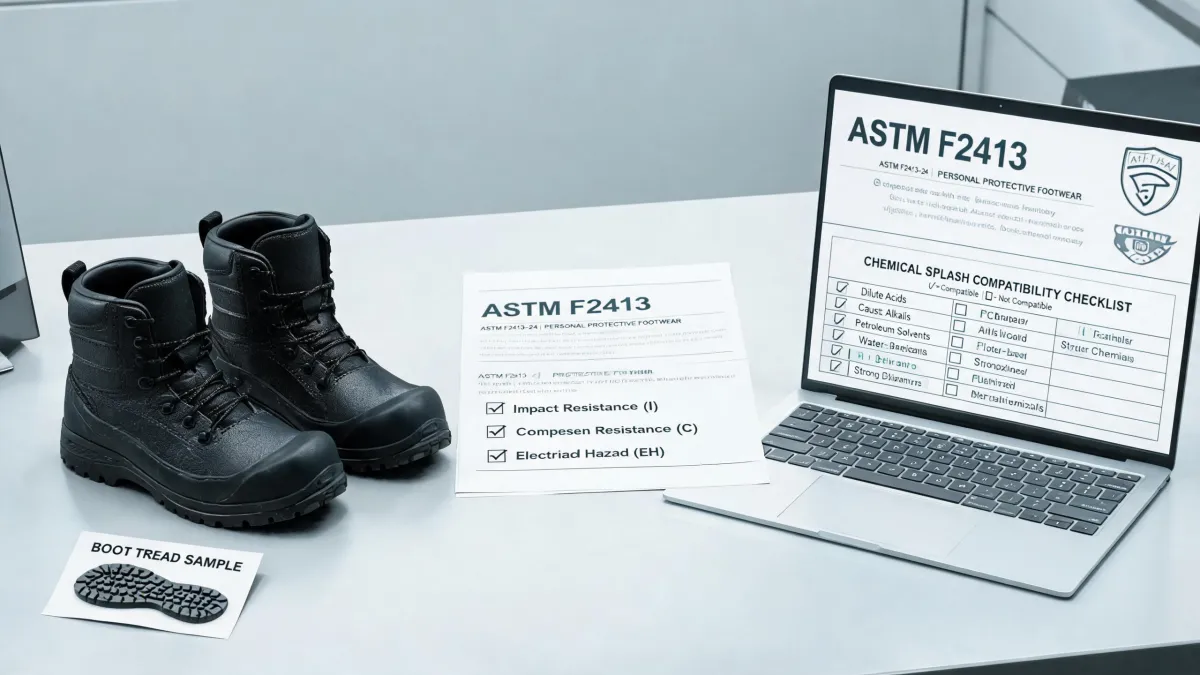
ASTM F2413-18 is the most common safety footwear standard in North America, but it's not the only one. Your site might also need CSA Z195 compliance if you operate in Canada, or EN ISO 20345 if you follow European standards.
I once ordered 32 pairs of what I thought were fully certified Dunlop boots. What I mean is I assumed the certification was universal. It wasn't—the model I picked had US certification but hadn't been evaluated under CSA. $1,100 in cross-border return fees and a two-week delay.
Check the label inside each boot. Every certified pair has a marking showing which standard it meets. No marking? Send it back.
Step 3: Match the rubber compound to your chemicals
Dunlop makes different rubber boots for different environments:
- General-purpose rubber boots — waterproof, good traction, basic splash resistance
- Hazmat boots — tested to specific chemical resistance standards like ASTM F739
- Insulated boots — for cold environments
- Foundry boots — for heat and molten metal splash
Not all hazmat boots handle every chemical. The rubber compound determines what the boot can resist, and the manufacturer's chemical chart tells you exactly what that is. If the supplier can't produce that chart, that's a red flag. Walk away.
Step 4: Size up for steel toe—and test with work socks
Steel toe boots fit differently than soft-toe versions. The toe cap takes up room, so most people need at least half a size up from their normal fit. In my experience, a full size is safer for pull on work boots—which is what Dunlop's rubber boots mostly are.
The conventional wisdom is to order your regular shoe size. My experience with 200+ boot orders suggests otherwise. A tight steel toe causes real foot problems over a 10-hour shift. I've had crew members complain about toe numbness and blisters because the boot was half a size too small—kinda the opposite of what safety boots are supposed to do.
(Should mention: I keep a pair of "work socks" in the office specifically for fit testing. It sounds small, but it eliminates a lot of gripes down the road.)
Step 5: Order one test pair before bulk committing
For bulk orders, don't commit to 60 pairs before checking one. A single test pair costs around $50 (as of March 2025) and takes about a week. A wrong bulk order costs thousands and can halt your site's safety compliance.
Here's the part vendors don't tell you: most will sell you a single pair at the bulk price if you're clearly going to place a larger order later. You just have to ask. I didn't know that for my first three years of ordering, and I paid for it more than once.
This step is the most skipped, and in my opinion, it's the one that saves the most money.
Step 6: Inspect every pair on delivery
When the order lands, don't just count boxes. Inspect every pair:
- Check certification labels—each pair, not just one
- Look for date codes (rubber degrades over time, even on the shelf)
- Verify the sole matches what you specified
- Confirm steel toes are actually steel—a magnet works
On a 47-pair order last year, I caught 9 pairs with incorrect toe markings doing exactly this. That's $2,800 in potential rework avoided by 30 minutes of inspection. The inspection process is fairly straightforward once you know what to look for.
Step 7: Set a replacement schedule, not a "buy when worn out" policy
Safety boots aren't buy-once items. Rubber degrades, traction wears down, and steel toe caps can sustain hidden damage from impacts. I recommend tracking in-service dates for every pair, even if it's just a sticker on the sole and a note in a spreadsheet.
For harsh chemical environments, I'd argue for replacing Dunlop hazmat boots every 12–18 months depending on exposure frequency. Compare the cost of that to a foot injury claim, and the math is obvious. Prevention is always the cheaper route.
Safety Glasses vs Safety Goggles: The PPE Gap I Keep Seeing
Something I see on nearly every site: perfect boots, wrong eye protection. The safety glasses vs safety goggles question comes up constantly, and it matters more than people think.
Safety glasses protect against flying debris. Safety goggles form a seal around your eyes, protecting against splashes and fine particles. For hazmat environments, goggles are usually the right answer—chemical vapor can reach your eyes through the gap between glasses and your face, and most people don't realize that until it's too late.
And if you're comparing Carhartt steel toe boots to Dunlop rubber boots as an either/or decision: they're different tools. Carhartt makes solid leather boots for dry environments. Dunlop rubber boots are the better call where water, chemicals, or mud are present. I own both, and I use both—just on different jobs.
That's the checklist. It took me 11 mistakes, $9,500, and a few too many audit headaches to build it. Use it on your next order, and you might skip the painful part—because 5 minutes of verification beats 5 days of correction.