-
Why Dunlop boots became our default (and why I almost didn't switch)
-
N95 masks: Stop searching "near me" and start checking the TC number
-
Safety glasses vs safety goggles? You're asking the wrong question
-
The counterargument: "But my team doesn't work in these conditions"
-
What I'd check this week if I were you
Let me start with an opinion that might annoy you: A lot of teams don't have a PPE cost problem. They have a "cheapest per unit" problem. That's my conclusion after six years of managing safety equipment purchases—about $180,000 in total spend, give or take. I've made the cheap mistake, I've paid for it in rush orders, and I've changed how our company buys boots, respirators, and eyewear.
This isn't a "buy the most expensive thing" argument. It's the opposite. You might be paying too much because you're ignoring what the equipment costs per month of actual use. And sometimes the "cheap" option is a lot more expensive than it looks.
Why Dunlop boots became our default (and why I almost didn't switch)
In 2020, I needed a waterproof rubber boot for crew members working around wet concrete and standing water. I didn't care about the brand. I cared about the price. I bought a generic boot at about $42 a pair. It looked fine out of the box. In hindsight, that's when you should be suspicious.
Within about 5 months—maybe 4, I'd have to check our maintenance log—the liner came out in one pair, and the sole started to split in another. One afternoon, a guy stepped into a puddle of curing compounds and walked around soaked for an hour before he could change. That's not a "wear and tear" story. That's a safety and morale problem.
I replaced those boots and did the math. The failed boots cost us $42 each, plus $248 in rush shipping, plus the overhead of troubleshooting a supplier that didn't want to honor a warranty. I still remember the line from their support page: "Warranty does not cover soles." Surprise, surprise.
So I switched to the Dunlop Chesapeake men's rubber boots plain toe for general site use. It wasn't the cheapest option. I want to say we paid somewhere in the mid-$50s, but don't quote me on that—it was 2020. The key difference wasn't the rubber. It was the fact that the boots actually stayed waterproof for more than one season. The reorder rate dropped. We stopped paying for replacement shipping.
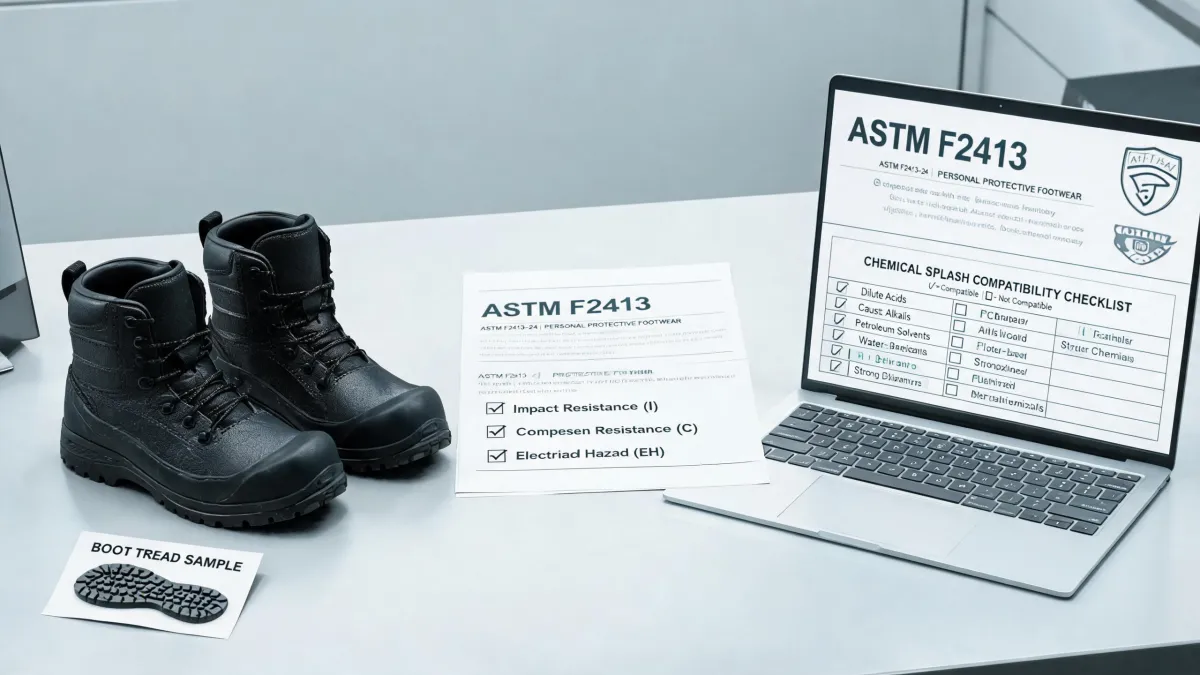
For higher-risk tasks, we order from the Dunlop safety boots waterproof line, including steel toe models where impact can happen. I should be clear: the Chesapeake plain toe is not a steel toe. If you need impact or compression protection, use a boot that meets ASTM F2413-18 impact and compression standards (Source: ASTM International). That's not a marketing preference. It's the difference between a boot and a safety boot.
N95 masks: Stop searching "near me" and start checking the TC number
I get it. When you're in a pinch, you search "N95 mask near me" and grab whatever the store has behind the counter. I've done it. We all have. But the more I tracked our PPE spend, the more I realized that convenient respirators can be a costly mistake—not financially, but in compliance.
Here's what I learned from a certified industrial hygienist who audited our program: an N95 isn't just a mask with two straps. It has to seal to your face, and it has to be tested by a recognized certifier. According to CDC/NIOSH (cdc.gov/niosh/npptl), approved respirators are marked with a TC-84A approval number. If you don't see that number, you don't know what you're buying.
I used to keep a box of masks in my truck. Now I check the box before I issue it. It took one audit finding—a "non-compliant dust mask" citation—to make me rethink our entire respiratory protection process. The "near me" convenience is useful. But it isn't a substitute for a certified product.
Safety glasses vs safety goggles? You're asking the wrong question
The "safety glasses vs safety goggles" question came up a lot in our own team, and I used to think the answer was "goggles are better." Now I think that's the wrong way to frame it.
Safety glasses vs safety goggles isn't a battle. It's a decision based on the hazard you're protecting against. In my experience:
- Glasses—like the Nemesis safety glasses we issue as our default—handle flying debris, dust, and general impact. They're light enough that people don't take them off every few minutes. That's important, because a safety product is only effective if it's actually on someone's face.
- Goggles give you a sealed enclosure. That's the right choice for chemical splash, fine particles, or anything that could get around the sides of a pair of glasses.
One of my biggest procurement mistakes involves this exact distinction. I sent a vendor a rate sheet that said "safety eyewear." I meant glasses. They read goggles. The result: 30 boxes of goggles that fogged up and made people miserable on a drywall job. I spent about $400 in shipping and restocking fees to fix it. It was a classic communication failure—we both said the same word but meant different things.
So now I write "glasses" and "goggles" separately. According to ANSI/ISEA Z87.1, high-impact-rated eyewear is marked with "Z87+" on the lens or frame (Source: International Safety Equipment Association). Our Nemesis safety glasses carry that mark. The goggles in our chemical cabinet carry it too. But they aren't interchangeable.
The counterargument: "But my team doesn't work in these conditions"
I hear you. And I want to be honest: this is not a universal recommendation. My experience is based on about 200 order lines from a mid-sized commercial construction company in the Mid-Atlantic. If you're running a dry lab, a food processing line, or a security team, your PPE needs are different.
Dunlop boots are great for wet and muddy environments. If your crews are rarely in standing water, the premium for waterproof rubber might not pay off. In that case, you might be better off with a lighter boot. And if you only need occasional N95 protection for construction dust, you don't need to load a closet with masks. You need enough inventory to fit-test your team and keep the boxes stocked.
The goal isn't to be loyal to one brand. The goal is to buy for the actual hazard, and to calculate total cost per month, not total cost per order. If a $75 boot lasts 18 months, that's $4.17 per month. If a $42 boot lasts 5 months, that's $8.40 per month—plus the cost of your time replacing it. The math isn't subtle.
What I'd check this week if I were you
If you're a buyer, purchasing manager, or owner who just wants to stop overspending on safety gear, here's a starting point:
- Pull your last 12 months of PPE orders. Group them by item category: boots, eyewear, respirators, etc.
- Calculate how long each item actually lasted in service. Use maintenance logs, reorder dates, or team feedback.
- Match the product to the hazard before comparing prices. A certified N95, a splash-protective goggle, and a waterproof boot are not commodities.
- Check certifications. ASTM F2413 for boots, ANSI Z87.1 for eyewear, NIOSH TC-84A for N95 respirators. If the product doesn't show one, don't buy it for a safety-critical task.
And if you're still looking for a recommendation: I'm not going to tell you that Dunlop is right for every team. I can tell you it was right for ours. For general wet-site work, the Dunlop Chesapeake plain toe is the boot I order. For impact-risk areas, I order a steel toe from the Dunlop safety boots waterproof lineup. For high-dust or splash tasks, I keep goggles on hand and don't let anyone substitute glasses. For daily eye protection, I've been happy with the Nemesis safety glasses. And for respirators, I don't start with a search for "n95 mask near me"—I start with a NIOSH-approved product and a clean fit test record.
That's not the flashiest approach. But after six years and about $180,000 in purchase orders, it's the one that got our budget under control. The next time you're choosing between a "cheap" pair of boots and a branded pair, run the math before you put them in the cart. Sometimes the cheaper option is a deal. A lot of the time, it's just the beginning of a more expensive story.