-
I Review Safety Boots for a Living. Here's How This Comparison Works
-
Protection & Compliance: Dunlop Chemical Resistant Boots Are a Different Category
-
Durability: The Counterintuitive Part
-
Comfort: You Can't Optimize for the Wrong Metric
-
Real Cost: The Transparency Talk
-
Quick Aside: Safety Glasses vs Safety Goggles
-
Which Boot Should You Actually Buy?
I Review Safety Boots for a Living. Here's How This Comparison Works
I'm the guy who reviews safety footwear before it reaches customers. Quality and compliance manager at a PPE distributor. I sign off on roughly 200 unique boot SKUs a year, and I've already rejected 7% of first deliveries in 2025 because of spec mismatches—wrong toe caps, missing ASTM stamps, rubber compounds that didn't match the datasheet. So when someone lumps "dunlop boots," "ariat work boots," and "merrell tactical boots" into one search, I get exactly what they're asking: which boot is actually right for my crew?
Let me be upfront about my bias: I care about specifications first, comfort second, and brand names dead last. Here's the framework I'll use:
- Protection and compliance—what the boots are actually certified to do
- Durability—how long they hold up in real work conditions, not showroom conditions
- Comfort—including the hard truth about break-in periods
- Real cost—with 2025 pricing, not ballpark guesses
And since the question always tags along in the same conversation, I'll settle the safety glasses vs safety goggles debate at the end.
Protection & Compliance: Dunlop Chemical Resistant Boots Are a Different Category
Let's get this out of the way: men's Dunlop rubber boots aren't competing with Ariat or Merrell on style. They compete on certified protection in environments where the other two genuinely don't belong.
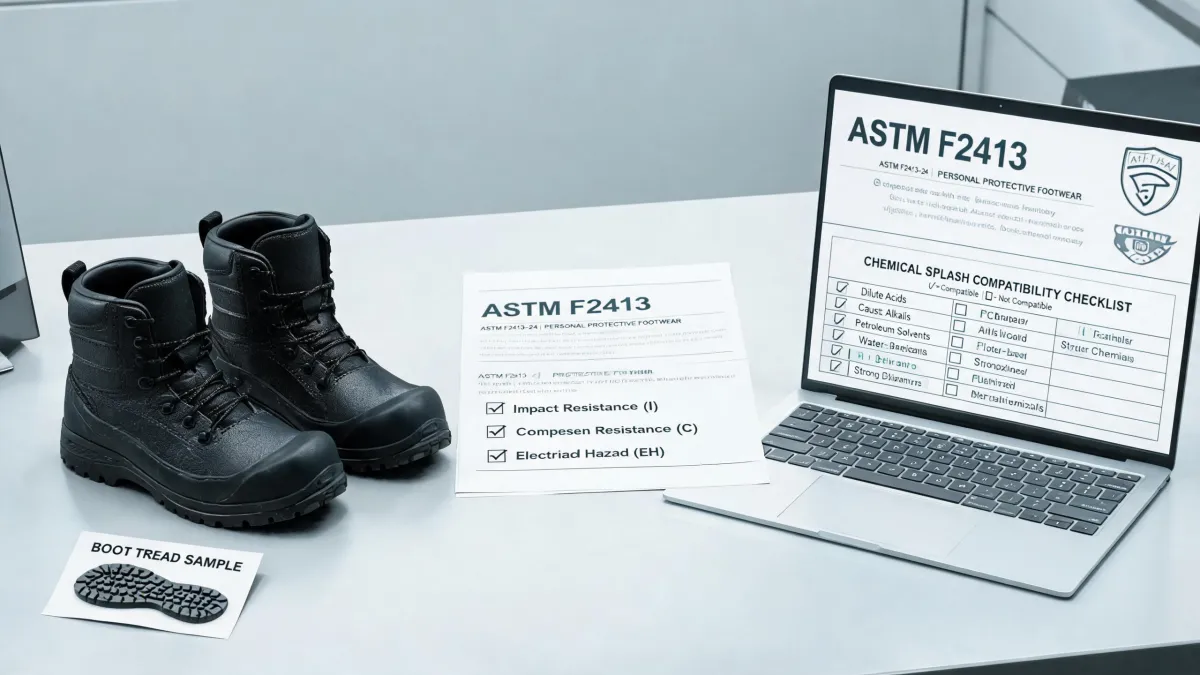
Dunlop built its reputation on rubber. The chemical resistant models—like the Hazmax series—are made from vulcanized rubber designed for chemical exposure. Steel toe variants meet ASTM F2413-18, the standard for impact and compression resistance. Hazmat models come with full documentation listing the specific chemicals, concentrations, and exposure times they've been tested against. I've held a Dunlop hazmat boot in one hand and its test report in the other. Batch numbers matched. The ASTM stamp was legible. That's what certified protection looks like.
Ariat work boots are a different animal entirely. They're built for ranch, farm, and dry construction. The Workhog series includes steel toe models that also meet ASTM F2413. But here's the catch that most buyers don't realize: leather is porous. A leather boot can pass impact tests and still absorb chemicals on the job. I've seen Ariat boots that looked fine on the outside but had degraded internal linings from chemical exposure. That's not an Ariat-specific flaw—it's a physics problem with leather in chemical environments.
Merrell tactical boots are in yet another lane. Lightweight, built for law enforcement and security, with models like the Moab 2 that feel more like hiking shoes than safety footwear. Composite toe options exist, and for urban patrol, they're hard to beat. But the breathable materials that make them comfortable also make them useless against chemical splashes.
Verdict: if the job involves chemicals, Dunlop chemical resistant boots are the only defensible choice. Ariat and Merrell make good boots—for environments where chemicals aren't part of the hazard profile.
Durability: The Counterintuitive Part
This is where buyers make expensive mistakes. They assume rubber boots are the "cheap" option and leather is the "investment." In wet, muddy, or chemical environments, that logic is backwards.
Dunlop rubber boots are seamless. Vulcanization creates a waterproof barrier with no stitching, no membranes, no waterproofing treatments that wear off. Last year I tested a pair of standard Dunlop boots against a 5% sulfuric acid solution, following the manufacturer's chemical resistance chart. The rubber held up. I ran the same test on a piece of leather work boot upper—it started degrading within hours. No amount of conditioner changes that.
Ariat uses quality full-grain leather. The Heritage and Workhog lines will last years on a dry ranch. But leather needs maintenance—cleaning, conditioning, proper drying. If your site is constantly wet or contaminated, leather breaks down a lot faster than people expect. I've seen $190 Ariat work boots last one winter on a wet site while $160 Dunlop boots lasted three seasons in the same conditions.
Merrell tactical boots have a different weakness: foam midsoles. The comfort you feel on day one comes from EVA foam, which compresses over time. After 6 to 12 months of daily wear, the cushioning is noticeably flatter. For a patrol officer, that's manageable. For someone standing 10 hours a day on concrete in an industrial setting, you're replacing them every year.
The counterintuitive conclusion: Dunlop boots often have the lowest cost per wear-cycle, even though they look like the "basic" option. Total cost of ownership favors rubber in wet, muddy, or chemically exposed environments. Period.
Comfort: You Can't Optimize for the Wrong Metric
I've made the mistake of recommending boots based on comfort alone. It went poorly.
Dunlop rubber boots have zero break-in. You pull them on, they fit, you work. The downside: they don't breathe. Ten hours in the summer and your feet are swimming. That's the price of a chemical barrier. Newer models like the FieldPro line include better anatomical shaping and cushioned insoles, which helps. But rubber is still rubber.
Ariat boots need a break-in period—usually a week or two before the leather molds to your foot. Once broken in, the ATS support system is legitimately comfortable for all-day dry wear. Most crews I talk to rate broken-in Ariats 8 out of 10. The problem is getting through the first two weeks without blisters.
Merrell tactical boots are the easiest out of the box. They feel like running shoes from day one—because they basically are. The Moab series is a hiking shoe with a tactical upper. That's why security and law enforcement guys love them. But comfort doesn't override protection. The most comfortable boot is still the wrong boot if it doesn't handle the hazards you're exposed to.
My rule: let the environment dictate the protection level, then optimize comfort within that category. Never work backward from comfort.
Real Cost: The Transparency Talk
Let's talk money, because nobody does this clearly.
In 2025 Q1 pricing, here's what you're looking at:
- Dunlop chemical resistant boots with steel toe: $140–$220. Hazmat-specific models: $250–$350.
- Ariat work boots with safety toe: $160–$230 for the Workhog, $180–$260 for Heritage lines with safety toe.
- Merrell tactical boots: $120–$170 for the Moab series.
Those numbers are in the same ballpark. So the real question isn't which boot is cheapest—it's whether the certification is real and whether the boot fits the environment.
I've learned to ask what's not included before asking the price. A vendor who lists all costs upfront—including certification docs, test reports, and compliance paperwork—earns trust. A vendor offering a "deal" without the paperwork? That's a red flag.
In my first year, I made the classic beginner error: assumed "waterproof" meant the same thing to every manufacturer. I approved a batch of 500 boots for a wastewater treatment client without verifying the membrane spec. About 200 pairs came back with compromised seams within a month. That cost us $6,000 in replacements and a client relationship I'm still rebuilding.
I still kick myself for not demanding third-party test reports on that order. If I'd checked the ASTM documentation and batch numbers before approving, I'd have caught the discrepancy before the boots ever shipped.
So glad I fixed that process, though. Last month, a replacement order of "certified" boots came in with test reports that didn't match the batch numbers on the boxes. We caught it during the routine document check—one click away from shipping 300 potentially non-certified boots to a chemical plant.
Quick Aside: Safety Glasses vs Safety Goggles
Since the question always tags along with boot searches, let's settle it like an inspector would.
Safety glasses are impact-rated eyewear. They meet ANSI Z87.1-2020, which means they can withstand high-velocity impacts—a 22mm steel ball traveling at 163 feet per second, to be precise. But they're open around the edges. Dust, particles, and especially chemical splashes can still get in from the top, sides, and bottom.
Safety goggles form a sealed barrier around your eyes. OSHA 29 CFR 1910.133 requires goggles wherever there's a risk of hazardous substances splashing into the eyes. Not "recommended"—required.
Same logic as the boots: hazard dictates the equipment. Grinding, sawing, or overhead work → glasses. Chemical handling or splash risk → goggles. If you're wearing Dunlop hazmat boots and a pair of open safety glasses at a chemical plant, you're half protected. The boots are right; the eye protection is wrong. A $12 pair of sealed chemical goggles closes the gap.
Which Boot Should You Actually Buy?
Here's my scenario-based answer, no hedging:
Buy Dunlop boots if:
- Your crew works around chemicals, wastewater, or hazmat materials
- The job site is wet or muddy for most of the year
- You need steel toe or metatarsal protection with waterproofing
- You track cost per season, not just the upfront price
Buy Ariat work boots if:
- You're in ranching, farming, livestock, or dry construction
- You prefer leather once it's broken in
- Chemical exposure isn't part of the job description
- You'll put in the maintenance—cleaning and conditioning
Buy Merrell tactical boots if:
- You're in security, law enforcement, or urban patrol
- You need zero break-in and athletic-shoe comfort
- You walk or stand on hard surfaces for most of your shift
- Your hazard profile is low-risk—no chemicals, no heavy industrial exposure
And for eye protection: if the job involves chemicals, buy the goggles. No debate.
One last tip from someone who's been burned: ask for certification documents before you place the order. When the boots arrive, verify the batch numbers match the documents. If they don't, reject the shipment. It's not about being difficult—it's about making sure the equipment your people wear is actually what the label claims. That one habit has saved me more headaches than any other.