-
What This Checklist Is For
-
1. Name the Hazard Before You Name the Model
-
2. Read the Standard on the Label
-
3. Calculate Cost per Wearing Hour
-
4. Fit Test With the Real Socks
-
5. Verify Authorized Sellers
-
6. Bundle In the Rest of the PPE
-
7. Set a Replacement Trigger
-
Three Mistakes I Keep Seeing
-
Bottom Line
What This Checklist Is For
I'm a procurement manager at a 40-person industrial maintenance company. I've managed a $180,000 annual PPE budget for the last six years, negotiated with 30+ vendors, and tracked every boot order in our cost tracking system. If that sounds like a lot, it's really just a spreadsheet and a stubborn refusal to buy the same thing twice.
This checklist is for anyone about to order men's Dunlop rubber boots for a crew. It also applies to Dunlop Chesapeake rubber boots, steel toe models, Hazmat boots, or whatever safety footwear you're evaluating. And if you've been searching "men's dunlap rubber boots" with an "a"—that's a common misspelling. It's Dunlop with an "o".
Here's the thing: I don't start with brand hype. I start with hazards, standards, and cost per wearing hour. The fundamentals haven't changed, but the execution has. What was best practice in 2020 may not apply in 2025, so verify current specs before you place an order.
This was accurate as of Q1 2025. Standards and availability change fast—check the current datasheets.
1. Name the Hazard Before You Name the Model
First question: what is the boot actually going to touch? Wet concrete? Diesel fuel? Caustic chemicals? Live electrical parts? Each one points to a different boot.
Dunlop makes a wide range: rubber boots, steel toe boots, insulated Fieldpro models, Hazmat boots, and the Chesapeake series. Men's Dunlop rubber boots are a solid starting point for wet work, but they are not one product. The Dunlop Chesapeake rubber boots are built for general-purpose wet conditions. Hazmat boots have chemical resistance ratings you need to match to your site.
Don't assume the word "rubber" means one spec. It doesn't.
Look, I'm not saying every Dunlop is right for every site. I'm saying the logo should be the last step, not the first.
2. Read the Standard on the Label
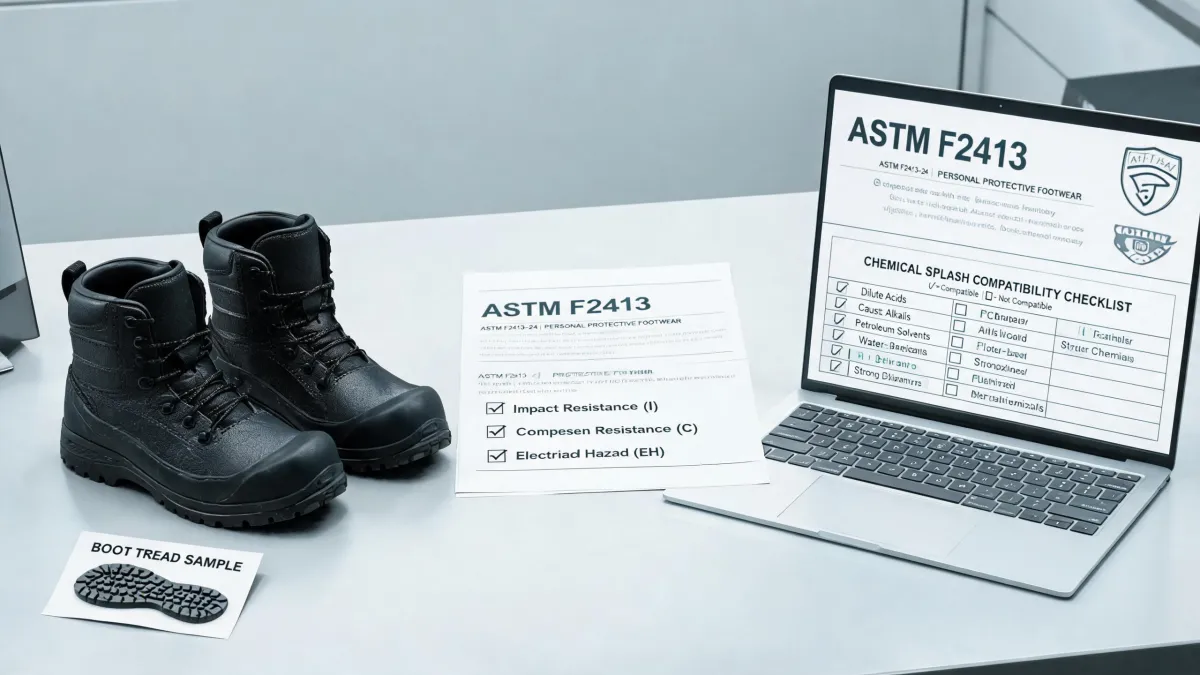
ASTM F2413 is the standard for impact and compression. Some boots add electrical hazard (EH) ratings or meet ASTM F2913 for slip resistance. The label should spell this out. If it doesn't, ask for the spec sheet.
According to OSHA 29 CFR 1910.136, employers must ensure that protective footwear is used when foot hazards are present. That means documenting the standard, not just trusting a "steel toe" stamp on the box.
No spec sheet, no PO. That's our rule.
We learned that after buying 40 pairs with "steel toe" on the box and no actual ASTM mark on the label. The distributor gave a refund, but we lost a week of work time.
3. Calculate Cost per Wearing Hour
Here's where procurement gets geeky. I compare boots using a simple TCO formula: (purchase price + replacement labor + downtime + disposal cost) ÷ expected wearing hours.
To be fair, a cheaper boot may win on sticker price. But if it needs replacing every five months while a Dunlop Purofort or Fieldpro lasts 14 months, the "cheap" boot costs more per hour. In Q2 2024, I compared three vendors for our quarterly order. The cheapest quote was 22% lower, but the projected replacement rate made it 31% more expensive over a year. We went with Dunlop.
For general wet work, the Dunlop Chesapeake series sits in a lower price band than Hazmat models. You can verify current ranges on distributor sites or Dunlop's product pages. Prices change, so don't budget off a blog post.
4. Fit Test With the Real Socks
Size charts are a starting point, not the final answer. Rubber boots run roomy. We order half a size up for winter crews and always fit-test with the exact socks employees will wear—thick wool or moisture-wicking, not cotton.
We didn't have a formal fitting process in the beginning. The third time we replaced wrong-sized boots, I created a one-page fit checklist: try both sizes, add the sock, check heel lift, wiggle toes. It cut size-related returns from 11 pairs per year to zero.
5. Verify Authorized Sellers
Counterfeit safety boots are real. Dunlop's Where to Buy page lists authorized distributors—use them. If a deal looks 40% below market, ask why. I've seen unauthorized "surplus" boots that were actually seconds or old stock. Not a bargain. A liability.
If someone on your crew asks about Brunt, the "who sells Brunt work boots" question is a distribution question, not a hazard question. I don't have direct purchasing experience with Brunt, so I won't compare. If you evaluate them, run the same checklist: hazard, standard, TCO, fit, authorized seller.
6. Bundle In the Rest of the PPE
Boots don't work alone. On an outdoor site, tinted safety glasses are not a fashion upgrade. They're part of the eye protection program, and they still have to meet ANSI Z87.1. I put tinted safety glasses on the same PPE list as boots, so nobody has to guess.
If your work is dry and doesn't require rubber, Ariat composite toe boots are worth a look for that narrow use case. I don't buy them for our wet work, but I don't dismiss them.
7. Set a Replacement Trigger
Don't rely on "looks fine." Write down the issue date and expected life. Set a replacement trigger: hours in service, visible cracking, sole separation, or failed compression test.
The first time we ordered 36 boots, we didn't track who got what size or model. Six months later, 14 pairs needed replacement, and I couldn't tell which boots had been in which environment. Now every pair is assigned to an employee in a spreadsheet. It sounds boring. It saves money.
Three Mistakes I Keep Seeing
- Buying the same boot for every job. A waterproof rubber boot is not the same as a chemical-resistant Hazmat boot.
- Believing "steel toe" equals all protection. It doesn't. Look for the ASTM label.
- Skipping the spec sheet because the sales rep sounds confident. Ask for the PDF.
One caveat: my experience is based on about 200 orders for mid-sized crews in industrial maintenance. If you're in food processing, chemical plant, or utility work, your specs might differ. Talk to your safety officer before copying my checklist.
Bottom Line
The fundamentals of buying Dunlop boots haven't changed: match the hazard, verify the standard, calculate the true cost, and track the lifecycle. The execution has transformed—more models, better materials, and more counterfeit risk. I do not buy on brand name alone, and neither should you.
The checklist: hazard first. Standard second. Price third. In that order. Use this checklist, adjust it for your site, and you'll spend less time replacing boots and more time working.