-
1. What exactly are Dunlop Dakota safety boots?
-
2. Are Dunlop rubber boots steel toe?
-
3. How do Dunlop boots compare to other men's work boots?
-
4. Are nitrile gloves heat resistant?
-
5. What size issues come up when ordering Dunlop boots for a crew?
-
6. How long do Dunlop safety boots actually last?
-
7. Do Dunlop safety boots meet OSHA and ASTM standards?
In my role coordinating safety equipment for industrial clients, I handle a lot of rush orders—boots, gloves, and on a bad day, both. Last quarter alone, we processed 47 rush jobs with 95% on-time delivery. The other 5% is where I learned my best lessons.
When I first started in this position, I assumed safety boots were a solved problem. Pick a size, check the safety rating, ship it. A few near-misses later—including one soft-toe order that almost went out to a steel-toe site—I know better. What was best practice in 2020 doesn't all carry over to 2025; standards get updated, boot construction changes, and suppliers have to keep up. But the fundamentals haven't changed: match the boot to the hazard, verify the certification, and deliver before the deadline.
Here are the seven questions I get asked most often, with the answers I wish someone had given me.
1. What exactly are Dunlop Dakota safety boots?
The Dakota line is one of Dunlop's workhorse series. It's built for wet, demanding environments—commercial fishing, agriculture, food processing, and construction sites where standing water is part of the shift. The defining feature is a continuous rubber outer shell. No stitching, no seam lines that fail over time. That creates a waterproof barrier that leather boots can't replicate, no matter how much treatment they get.
Most Dakota models include a reinforced toe cap and slip-resistant outsole, and they're available in both steel toe and soft toe variants. From the quotes I've seen in early 2025, you can typically budget around $60 to $120 per pair depending on the model and distributor. That's a rough range though—regional pricing varies, so verify current rates before your purchase order goes out.
What they aren't is a general-purpose boot. If your team works on dry floors most of the day, a lighter leather boot might be a better fit. The boot has to match the environment, not just the brand.
2. Are Dunlop rubber boots steel toe?
Not all of them—but many are. The confusion is understandable. When most people hear “rubber boot,” they picture a garden rain boot, and they assume it can't be real safety footwear. That assumption is outdated.
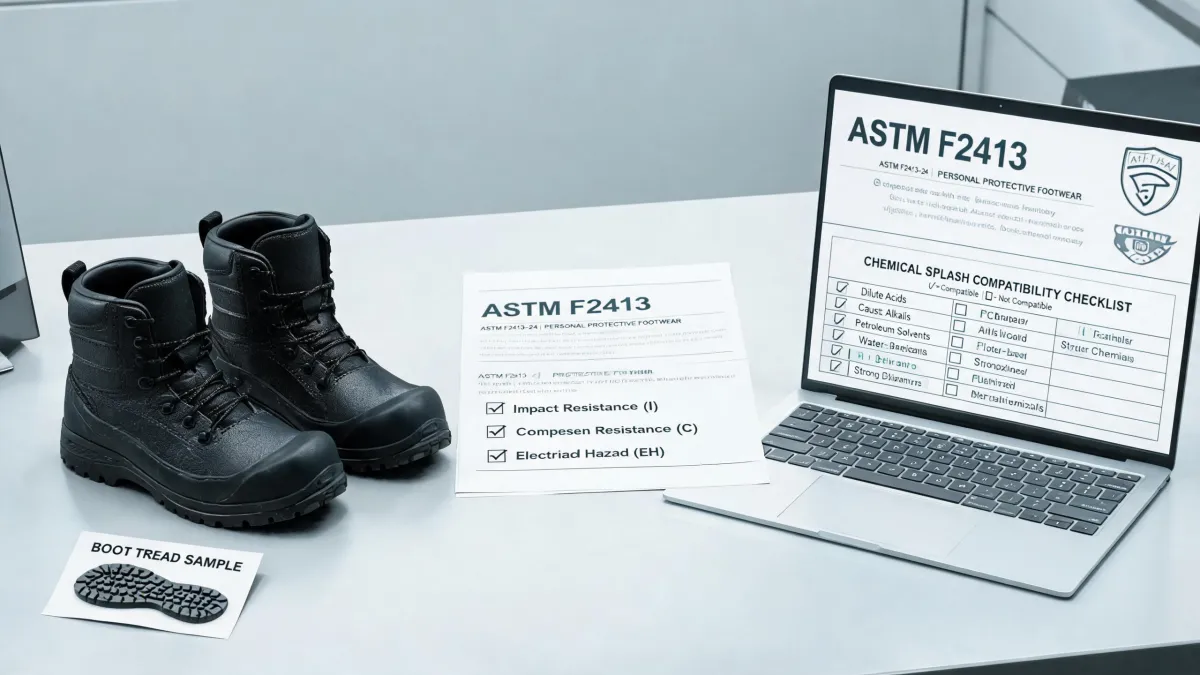
Modern vulcanized rubber work boots are tested and certified like any other protective footwear. The key is the ASTM F2413 mark. That standard covers impact and compression resistance, and when a boot carries it, the toe cap has been tested against defined performance levels. Look for that mark in the product listing, not just in the photos.
This matters more than you think. Earlier this year, a client almost ordered soft-toe Dunlop rubber boots for a site that required steel toe. The flag went up about 36 hours before a scheduled safety audit. We paid roughly $300 in rush shipping to get the correct pairs delivered in time, and the audit passed. The takeaway: verify the model number against its certification before you order, not after.
3. How do Dunlop boots compare to other men's work boots?
This is probably the most common comparison I get, and Ariat composite toe boots come up more than any other model. I understand why. Ariat makes a good boot, and composite toe is genuinely lighter than steel, which matters when you're on your feet for ten hours a day.
The thing is, the comparison misses the point. Ariat primarily builds leather boots for dry environments. Dunlop builds rubber boots for wet and chemically exposed ones. If your crew is standing in process water, cleaning chemicals, or thick mud all shift, a leather boot—composite toe or not—can soak through and crack where the stitching meets the sole, turning into a hazard itself. A rubber boot handles that environment all day.
On the other side, if your work site is dry and hot, a rubber boot can feel heavy and trap heat. There's no universal winner. I've supplied both to different crews and seen each type fail when used in the wrong setting. Choose based on the work site and the specific hazards, not the brand name.
4. Are nitrile gloves heat resistant?
No. I want to be direct about this because the question keeps coming up in safety conversations. Nitrile gloves are chemical-resistant, not heat-resistant. They handle a wide range of oils, solvents, and acids that would break down latex or vinyl. But against hot surfaces, open flames, or high-temperature processes, nitrile is the wrong tool.
Some nitrile gloves offer limited protection during brief contact with warm objects—think handling a warm cup, not grabbing a metal pipe at 150°C. If the task involves real heat, you need gloves specifically rated for thermal protection, such as Kevlar or other purpose-built heat-resistant materials.
Why does this come up in a boots article? Because hazmat and chemical crews often get both issued at the same time, and both can be rubber-based. It's easy to assume that similar materials mean similar properties. They don't. Check the temperature rating on the glove's data sheet, the same way you'd check the ASTM rating on a boot.
5. What size issues come up when ordering Dunlop boots for a crew?
Predictable ones, mostly. Crews span a wide range of sizes, and rubber boots fit differently than leather ones. A crew member who wears size 8 in leather might need a 9 in a rubber boot because the material doesn't stretch the same way. Another might prefer a half-size down if they wear thick work socks.
The other issue is the crew itself. Men's work boots generally run wider in the toe, and if you have women on the team, you may need to order a size down or check the model's unisex sizing guidance. It sounds small until the exchange process eats a week of your deadline.
Our internal policy now requires a 48-hour buffer on every new boot order—something we adopted after a 2023 incident when a client had to swap nearly half of a 24-pair order two days before a plant shutdown. We paid $650 in overnight shipping. Actually, it was closer to $700 with the weekend surcharge. It hurt, but missing the client's deadline would have triggered a $50,000 penalty clause in their contract. The buffer is worth it.
If you're outfitting a large team, order a few trial half-sizes in the most common sizes first. It's cheaper than any rush exchange.
6. How long do Dunlop safety boots actually last?
It depends more on the environment than almost anything else. In food processing or a clean manufacturing floor, a well-kept rubber boot can go 12 to 18 months. On a heavy construction site with sharp debris, six months is a solid run.
From the replacement orders I've managed, roughly 7 out of 10 boots fail at the sole rather than the upper. The advice that has held up across everything I've seen: check soles for wear, inspect uppers for cracks at the flex points, and replace boots before they fail—not after someone notices water inside.
What has changed over the years is the compound. Modern rubber formulations resist chemicals and abrasion in ways that old rubber couldn't. So I'm not saying “they don’t make them like they used to.” The opposite. They're making them better.
One more thing worth remembering: a leaking boot is no longer a safety boot. If the barrier that keeps water out has failed, it also won't keep chemicals or other hazards out.
7. Do Dunlop safety boots meet OSHA and ASTM standards?
Most Dunlop safety-rated models are certified to ASTM F2413, the standard that OSHA's foot protection rule references. But “most” is the important word. Not every model in the catalog is a safety shoe, and not every safety-rated model has the same level of protection.
OSHA requires employers to provide foot protection when employees face certain hazards, and it points to ASTM standards as the benchmark for what counts as protective footwear:
“The employer shall ensure that each affected employee uses protective footwear when working in areas where there is a danger of foot injuries due to falling or rolling objects, objects piercing the sole, and/or electrical hazards” — 29 CFR 1910.136(a), OSHA, U.S. Department of Labor
Before you place a large order, do two things. First, pull the spec sheet for the exact model number and confirm the ASTM mark. Second, confirm the rating matches your specific site hazards—impact, compression, metatarsal, electrical. They're not the same thing.
I'm not a compliance consultant, so I'm not going to pretend to interpret the rulebook for you. What I can tell you from the procurement side is that model numbers and certifications go together. If a supplier can't tell you the ASTM rating of a boot without checking, that's a warning sign. It's exactly the kind of missing detail that gets a shipment rejected at the gate—or worse, costs someone an injury.