Back in early 2024, I was in my second year as the office administrator for a mid-sized chemical distribution company in Texas. Roughly 180 employees across two facilities. I handled all the PPE orders—about $60,000 annually across maybe 6 or 7 vendors. It was one of those roles that sounds administrative but turns into operations real fast when someone's boot splits open on the plant floor.
Honestly, I thought I had the procurement part figured out. Then a request for new chemical-resistant boots came in, and I made a decision that taught me a lesson I still use today.
The Request That Started It All
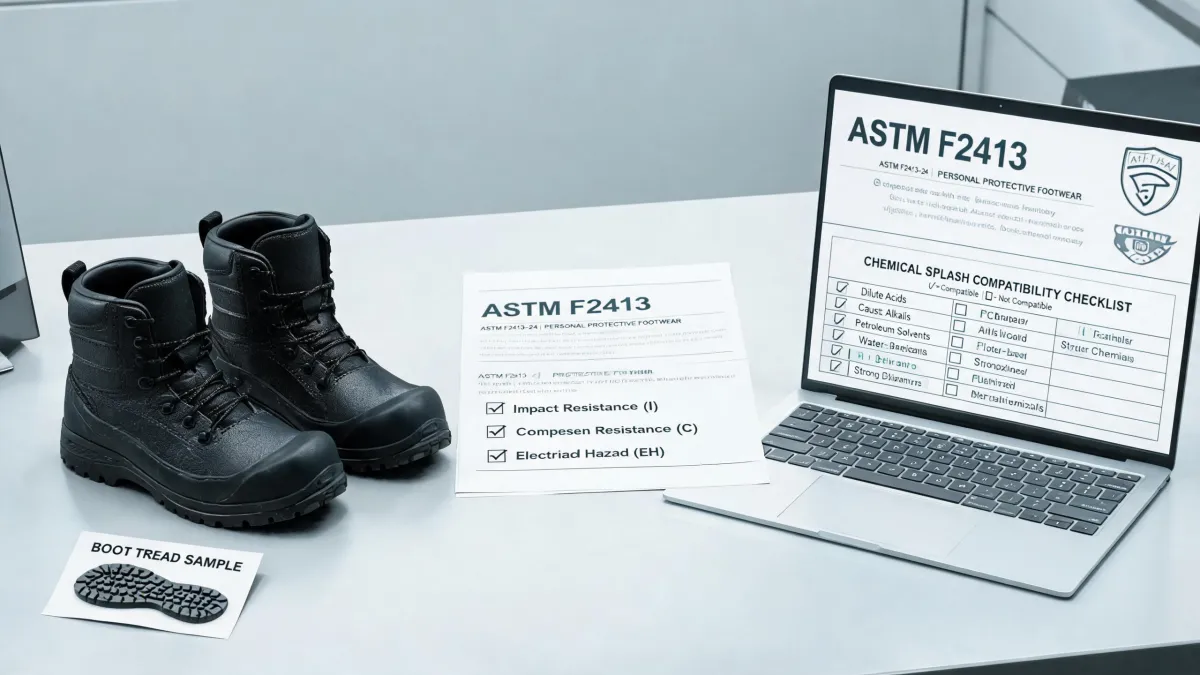
Our warehouse lead came to me in February. He needed 15 pairs of chemical-resistant boots for a new handling line. He sent me a spec sheet: must be steel toe, must handle acid splash, must meet ASTM F2413. Standard stuff for our environment.
I did what I always did. I got three quotes. The cheapest option came in at $65 per pair from a brand I hadn't worked with before. Dunlop—the rubber boot people—quoted $94 for the Dunlop Hazmax series. The middle option was about $82.
You can guess where my spreadsheet pointed me. I ordered 15 pairs of the $65 boots. Saved the company $435 on the line item. I felt good about it (ugh, rookie move).
But two weeks later, the first complaints came in.
The Hidden Cost Reveal
It started small. "These boots are stiff." "They chafe after four hours." I figured—people always complain about new boots, right? At least, that's been my experience.
Then the real issues hit. By week four, three employees had reported heel separation. One guy got chemical splash on his ankle because a seam split near the top. No injury—thankfully—but it triggered a safety report. My boss got copied on that.
By month two, I had ordered 8 replacement pairs. The vendor refused to refund—they said it was "normal wear in industrial use." Which, I mean, maybe? But still. I ended up buying 8 pairs of another brand (Dunlop) to swap them out. The total cost on that little adventure:
The $65 boots: $975 for 15 pairs
Replacements: $752 for 8 pairs of Dunlop Hazmax at $94 each
Shipping & penalties: $140 for rush shipping on the Dunlop order
Downtime: Hard to quantify, but the shift supervisor told me they lost about 12 man-hours dealing with boot issues over two months.
That $435 savings disappeared fast. I want to say the true TCO landed around $1,870, though I might be misremembering the exact admin overhead. Point is—it was more than the Dunlop order would have cost upfront.
What I Actually Learned About TCO (The Hard Way)
I started tracking all my PPE purchases differently after that. I built a little spreadsheet—nothing fancy—with columns for unit price, return rate, and reorder frequency. The numbers told a pretty clear story.
For chemical-resistant boots specifically, here's what I now consider before comparing unit price:
- Seam construction: Vulcanized vs. glued. Glue fails faster in chemical environments. The Dunlop Hazmax uses vulcanized layers—it's a rubber integrity thing. That matters when hydrochloric acid is a daily factor.
- Fit consistency: If boots run small, people skip wearing them. That's a safety issue and a compliance risk. Per FTC advertising guidelines (ftc.gov), claims about product performance need substantiation—and fit is part of that expectation.
- Washability: This sounds minor, but how to wash work boots properly affects their lifespan. Cheaper boots sometimes use inner linings that degrade after one or two wash cycles. The Dunlop boots held up after repeated rinsing—honestly a big deal when you're dealing with chemical residue.
I also realized I had been falling for a simplification fallacy. It's tempting to think you can compare unit prices and get a reliable 'value' metric. But identical specs from different vendors can result in wildly different outcomes. The spec sheet said 'chemical resistant,' but not all chemical resistance is created equal.
The risk I weighed originally: save $435 on the line item, look good to finance, but risk reliability. I calculated the worst case—complete redo at $1,500+ in replacements. Best case—they work fine, save money. The expected value said go for the cheap option, but the downside felt... well, it felt like something I'd have to explain to my VP. And I did, unfortunately.
Where I Landed (And Why I Still Use Dunlop)
I'm not saying all cheap boots are bad. But for chemical environments, the margin for error is low. I switched the account over to Dunlop Hazmax for the plant floor, and we use their insulated rubber boots for cold room work. Also picked up a few pairs of Avenger work boots for maintenance crew—different spec, same reliability.
Funny enough, I also ended up ordering Nemesis safety glasses from the same supplier because they consolidated my shipping. By the time I reorganized our vendor list in mid-2024, we had cut from 7 vendors to 4. Processing about 50 orders quarterly instead of 80. Accounting was happy. My VP noticed.
Per USPS pricing (usps.com, March 2025), shipping for a single box of boots runs $18–25 depending on weight and zone. But if you're ordering in bulk through a supplier that consolidates—like we did—you can cut that per-unit cost significantly. It's the kind of TCO detail nobody thinks about until they see the line items.
Let me rephrase that: It's the kind of detail I didn't think about. Now I do. And I check for Dunlop boots near me when I need to source locally, because shipping is less, returns are faster, and I can actually inspect the product before committing to 20 pairs.
A Quick Note on Boot Maintenance
One thing I get asked a lot is how to wash work boots—especially chemical-resistant ones. Here's what I've learned:
- Rinse with cool water immediately after exposure. Don't let chemicals sit on the rubber or leather.
- Use mild soap—nothing with bleaching agents. Dunlop actually recommends their own boot cleaner, but dish soap works in a pinch.
- Air dry at room temperature. Heat from dryers degrades vulcanized rubber seams faster. I had a guy microwave his insoles once (don't ask).
- Inspect seams and soles weekly if you're in chemical environments. If you see cracking, it's time to replace.
Final Thought (and a piece of advice)
If I could go back to February 2024, I'd tell myself: Don't just compare the price per pair. Compare the cost per month of usable, reliable protection.
The $65 boots lasted me about 3 months before the issues started. The Dunlop Hazmax pairs we replaced them with? Still going strong after 8 months, with routine washing. At $94 per pair, that's about $11.75 per month. The cheap boots? $21.67 per month after replacements and shipping—and that's not counting the lost time and the VP conversation I'd rather forget.
Bottom line: TCO thinking doesn't just save money. It saves time, headaches, and the occasional awkward budget review. And if you're sourcing boots for a team, that's worth more than a spreadsheet can show.
(Oh, and if you're searching for dunlop rubber boots near me—check industrial supply houses, not just big box stores. The pricing differences are wild. I found a pair at a local safety supply shop that was $10 cheaper than the online listing.)