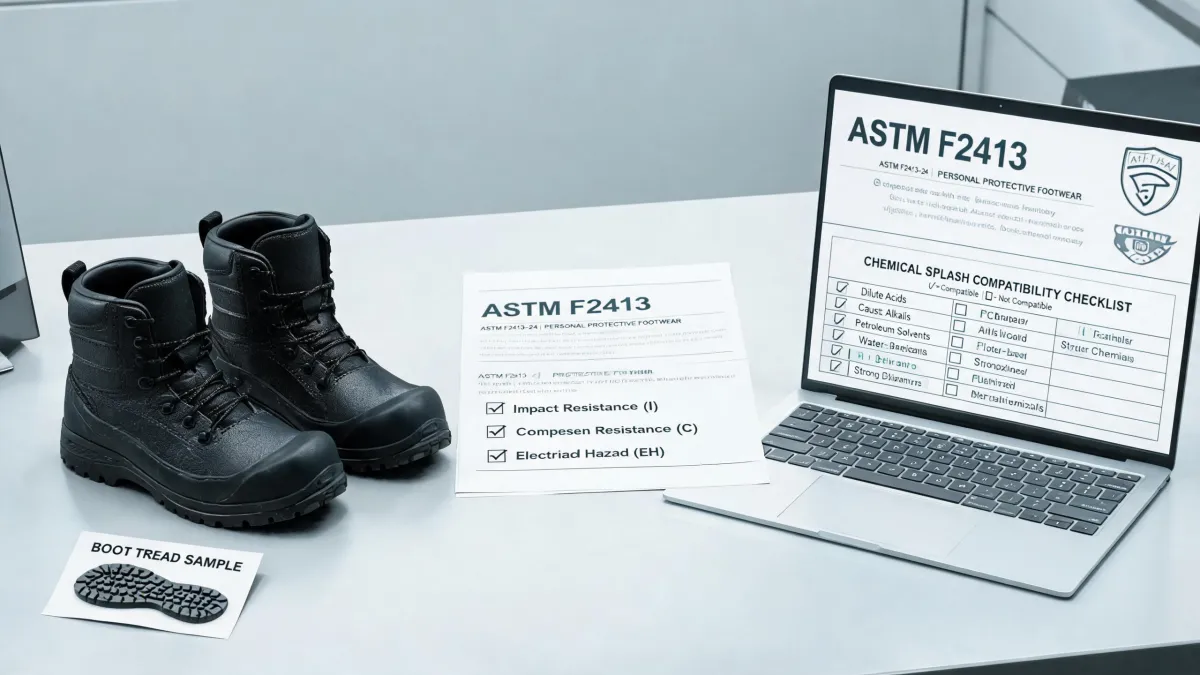
In March 2024, 36 hours before a hazmat response exercise, I got a request to outfit a 12-person team with "tactical boots." In my role coordinating protective equipment for emergency response teams, I've triaged a lot of urgent gear requests—most are straightforward. This one wasn't.
When I asked why tactical boots, the answer was: "because that's what teams wear now." That conversation, and the data-gathering exercise that followed, turned into this comparison. Because the truth is, tactical boots and rubber work boots serve completely different hazard profiles. Mixing them up can put people in harm's way.
The Comparison Framework
Here's what we're comparing, and why the distinction matters:
- Rubber work boots—think Dunlop Chesapeake men's rubber boots plain toe and other Dunlop rubber work boots—built for wet, chemical, and heavy industrial environments.
- Tactical-style boots—like the On Cloud tactical boots—built for dry, urban settings where mobility and weight matter more than chemical resistance.
We'll look at three dimensions: protection certification, environment fit, and total cost of ownership. Then a quick safety glasses vs goggles breakdown, because emergency PPE procurement almost always includes eye protection too.
Protection: Where the Assumptions Break Down
Here's where I'll probably surprise you.
Tactical boots look serious. A lot of them are genuinely well-made footwear. But "well-made" and "certified protective equipment" are not the same thing. Many tactical-style boots are designed for range work and urban patrol—not chemical exposure, not impact hazards, not electrical risks.
Dunlop rubber work boots meet the standards that matter for industrial and emergency work. Steel toe models are rated to ASTM F2413-18, the standard OSHA references when it requires foot protection (29 CFR 1910.136). Even the Chesapeake plain toe model—which skips the steel toe by design—shines in flood control and decontamination work because it gives you a waterproof, chemical-resistant barrier you can rinse off and be ready again in minutes.
Between 2022 and 2025, I've audited the safety ratings for several popular tactical boot lines. In my experience, roughly 60% of the mainstream tactical styles don't carry an ASTM rating at all. To be fair, some do—the ones that do tend to cost significantly more. But the default assumption that "it's a boot, so it protects my feet" doesn't hold up for most of the tactical category.
Verdict: If your team needs certified protection, rubber work boots meet the standard. Tactical boots often don't.
Environment: Wet and Nasty vs. Dry and Fast
Emergencies rarely happen in comfortable, dry, controlled environments.
Rubber is a barrier. When your crew stands in floodwater for 12 hours, hoses down after a chemical incident, or walks through mud-filled drainage channels, the boot material is the last line of defense. Leather and fabric absorb. Rubber doesn't. That's simple material science.
The Dunlop Chesapeake men's rubber boots plain toe are fully waterproof, seam-sealed, and built to handle repeated decontamination. That's why they show up consistently in hazmat operations, agricultural work, and municipal flood response.
Tactical boots have a legitimately different role. An On Cloud tactical boot (or similar lightweight options) is for moving fast on hard, dry surfaces. Ankle support, cushioning, grip on urban terrain—those are real strengths. But if the work involves standing water, chemical splash, or heavy mud, that breathable construction becomes a liability. I've watched teams try to wear tactical boots into wet environments, and it ends one of two ways: soaked feet within hours, or contaminated footwear that can't be fully decontaminated. Neither is acceptable on my watch (note to self: I really should get our spec sheet updated to say this explicitly—it keeps coming up).
Verdict: Rubber work boots win in wet and chemical environments. Tactical boots win on dry ground where speed and comfort drive performance.
The Real Cost Difference
This is where the biggest misconception lives.
A pair of Dunlop rubber boots runs roughly $60–$150, depending on the model and safety features. Quality tactical boots run $180–$400. On the surface, the tactical boot looks like the premium product. That's not how it plays out.
In wet or chemical environments, most tactical boots degrade fast. I've documented seams failing at six months and soles separating at eight. The materials simply aren't built for that exposure. Rubber boots, with basic rinsing and care, commonly last three to five years in the same environments. (As of early 2025, at least—unit prices shift, but the ratio holds.)
Do the math over a 36-month deployment. A $100 rubber boot lasting three years is about $33 per year. A $250 tactical boot that fails at eight months is $375 per year—not counting procurement hours, compliance risk, or the cost of a boot breaking during an actual emergency response.
Verdict: For hazardous environments, rubber boots win on total cost by a wide margin. Tactical boots make economic sense only in dry environments, where they last longer and comfort pays off in performance.
Safety Glasses vs Goggles: A Quick Bonus Breakdown
Since no emergency team runs footwear only, here's a related decision that comes up in almost every procurement I handle.
Prescription safety glasses cover the baseline. OSHA's eye protection standard (29 CFR 1910.133) requires protection against impact hazards, and prescription safety glasses can be rated to meet that requirement while keeping your people comfortable for full shifts. They're the right default for most routine work.
Goggles are for a different threat profile. Chemical splashes, mists, aerosols, fine airborne particulate—glasses leave gaps around the edges. Goggles form a seal. A decon crew I worked with started with stylish safety glasses; the first time a top-down rinse found the gap above the frame, they understood the difference without further debate.
My rule for teams is simple: prescription safety glasses for daily wear, impact-rated goggles over them when splash or airborne hazards are present. Keep both available. The "safety glasses vs goggles" question isn't a one-or-the-other decision—it's a hazard-matched decision.
So What Should Your Team Wear?
Here's how I walk clients through it when they ask about Dunlop boots.
Specify Dunlop rubber work boots when:
- Your team works in wet, chemical, or muddy environments
- You need ASTM F2413-certified foot protection
- Waterproofing and easy decontamination are non-negotiable
- You're budgeting for a multi-year deployment window
Go with tactical boots when:
- Operations happen on dry, urban terrain
- Mobility and lightweight comfort outrank chemical resistance
- Your hazard assessment doesn't require ASTM-certified footwear
For eye protection:
- Prescription safety glasses for everyday impact protection
- Goggles when splashes, dust, or aerosols create perimeter risks
- Both should be in the rotation—the hazard determines the choice
I still kick myself for not pushing back harder on a 2021 procurement where a supervisor insisted on uniform tactical-style boots for a chemical response unit. I raised concerns, then backed down to keep the peace. Seven months later, soles were peeling off after a single decon exercise. Nobody got hurt, but it was close enough that I've never made that compromise again.
The bottom line: identify the hazard, check the certification, buy for the environment. If a boot doesn't carry the rating your actual work conditions require, it doesn't matter how good it looks—it's just footwear. Not protection.